 Image 1 of 3
 Image 2 of 3
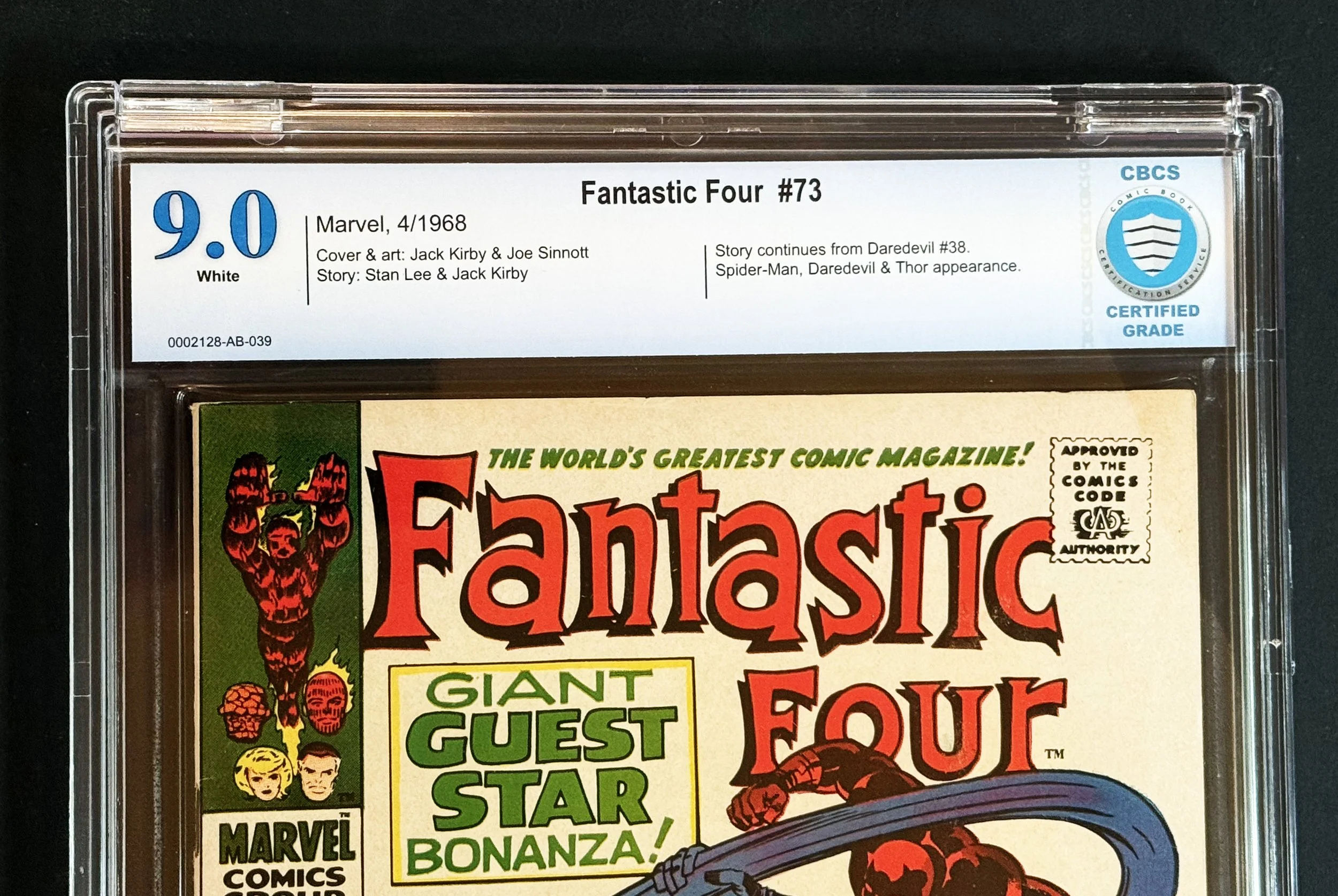 Image 3 of 3
This is a comic about a message that nobody will let anyone finish delivering.
The trouble starts one title over. In Daredevil #38, Doctor Doom trades bodies with Matt Murdock — a scheme that ends, as these things do, with Murdock restored and Doom still at large and still planning. Daredevil, knowing what is coming, goes to the Baxter Building to warn the Fantastic Four. The Fantastic Four take one look at the man in red and conclude that Doom is still inside him.
And so the Human Torch attacks a man who came to help. Daredevil, who cannot afford to hurt him, lures him into a water tower instead. Spider-Man arrives, listens, believes him, and leaves to find backup — returning with Thor. Now the misunderstanding has four more limbs. Three heroes are trying to warn the building; four heroes are certain the warning is a trap; and Jack Kirby, who never met a misunderstanding he could not choreograph, gives the rest of the issue over to the fight.
It should not work as well as it does. There is no villain present. Nothing is resolved until Sue Storm walks in and explains the obvious. Kirby was, by 1968, visibly running out of patience with Marvel, and this issue is not where his ambitions were. But the man could not draw a dull page if you paid him to, and twenty pages of superheroes hitting each other for no good reason is still twenty pages of Kirby and Sinnott at the height of their partnership.
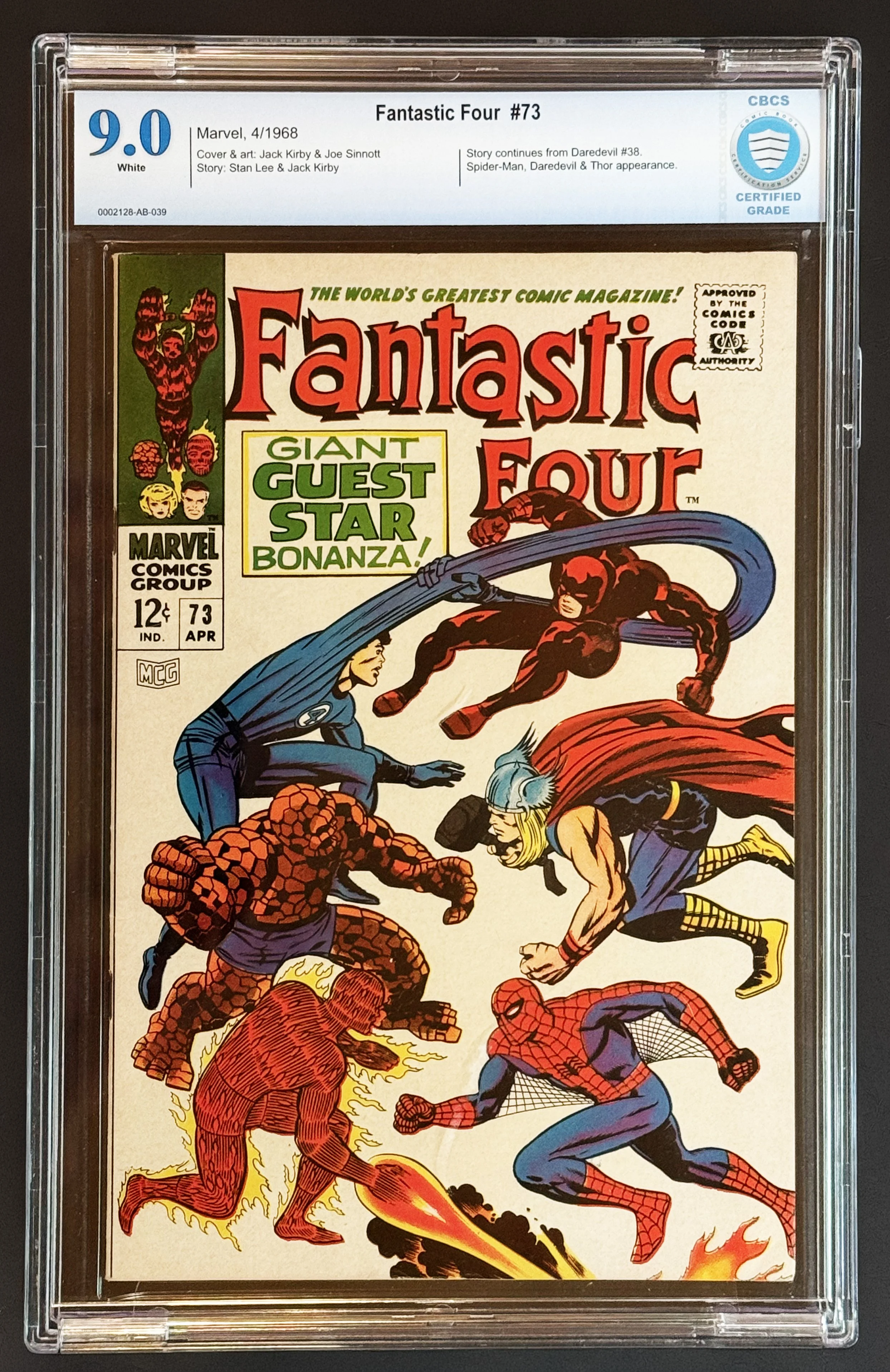
The cover alone justifies the book. Six figures, all moving, arranged so the eye travels: Daredevil vaulting in on Reed’s stretched arm at the top, Thor striding through the middle, the Torch and Spider-Man streaking across the bottom of the frame with the Thing anchoring the left. GIANT GUEST STAR BONANZA, the banner says, in the plainest possible language, and it is not overselling.
It is worth noting what this issue quietly did. By continuing directly out of Daredevil #38 — and later into Thor #150 — it asked Fantastic Four readers to buy comics they had not planned on buying in order to understand the one in their hands. Marvel would spend the next fifty years refining that idea. Here it is, nearly at the beginning, in a book that mostly just wanted to stage a brawl.
The statement of ownership inside reports an average press run of 329,536 copies a month. Almost none of them were bagged. Almost none were boarded. They were read on porches and traded at school and stacked in closets until the paper went brown.
This copy grades CBCS 9.0, Very Fine/Near Mint, with White pages — the highest page-quality grade CBCS assigns, on a book that turns fifty-eight this spring.
Ships in a Gemini graded-comic mailer with honeycomb kraft void fill, fully insured, within one business day of cleared payment.
This is a comic about a message that nobody will let anyone finish delivering.
The trouble starts one title over. In Daredevil #38, Doctor Doom trades bodies with Matt Murdock — a scheme that ends, as these things do, with Murdock restored and Doom still at large and still planning. Daredevil, knowing what is coming, goes to the Baxter Building to warn the Fantastic Four. The Fantastic Four take one look at the man in red and conclude that Doom is still inside him.
And so the Human Torch attacks a man who came to help. Daredevil, who cannot afford to hurt him, lures him into a water tower instead. Spider-Man arrives, listens, believes him, and leaves to find backup — returning with Thor. Now the misunderstanding has four more limbs. Three heroes are trying to warn the building; four heroes are certain the warning is a trap; and Jack Kirby, who never met a misunderstanding he could not choreograph, gives the rest of the issue over to the fight.
It should not work as well as it does. There is no villain present. Nothing is resolved until Sue Storm walks in and explains the obvious. Kirby was, by 1968, visibly running out of patience with Marvel, and this issue is not where his ambitions were. But the man could not draw a dull page if you paid him to, and twenty pages of superheroes hitting each other for no good reason is still twenty pages of Kirby and Sinnott at the height of their partnership.
The cover alone justifies the book. Six figures, all moving, arranged so the eye travels: Daredevil vaulting in on Reed’s stretched arm at the top, Thor striding through the middle, the Torch and Spider-Man streaking across the bottom of the frame with the Thing anchoring the left. GIANT GUEST STAR BONANZA, the banner says, in the plainest possible language, and it is not overselling.
It is worth noting what this issue quietly did. By continuing directly out of Daredevil #38 — and later into Thor #150 — it asked Fantastic Four readers to buy comics they had not planned on buying in order to understand the one in their hands. Marvel would spend the next fifty years refining that idea. Here it is, nearly at the beginning, in a book that mostly just wanted to stage a brawl.
The statement of ownership inside reports an average press run of 329,536 copies a month. Almost none of them were bagged. Almost none were boarded. They were read on porches and traded at school and stacked in closets until the paper went brown.
This copy grades CBCS 9.0, Very Fine/Near Mint, with White pages — the highest page-quality grade CBCS assigns, on a book that turns fifty-eight this spring.
Ships in a Gemini graded-comic mailer with honeycomb kraft void fill, fully insured, within one business day of cleared payment.