 Image 1 of 4
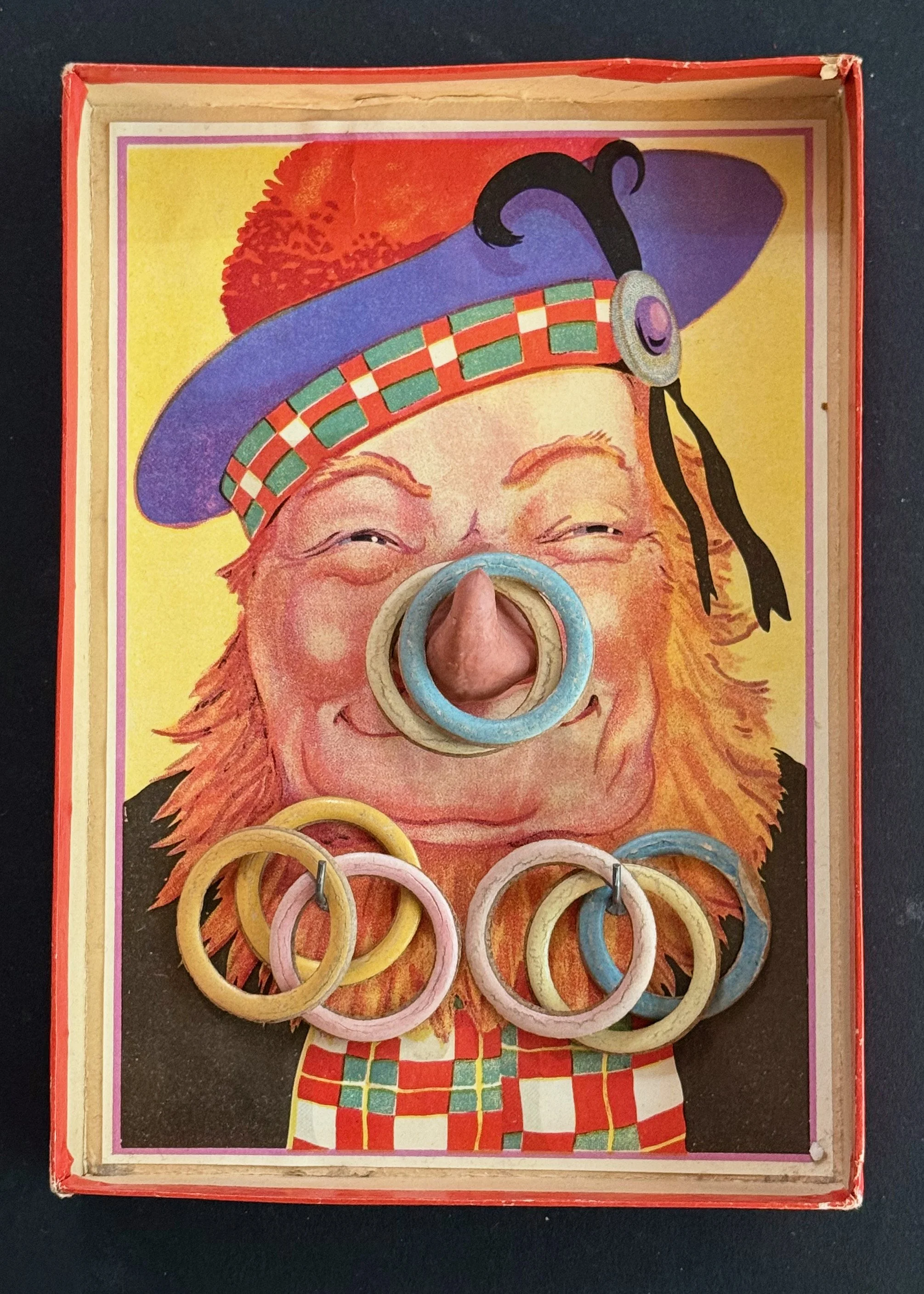 Image 2 of 4
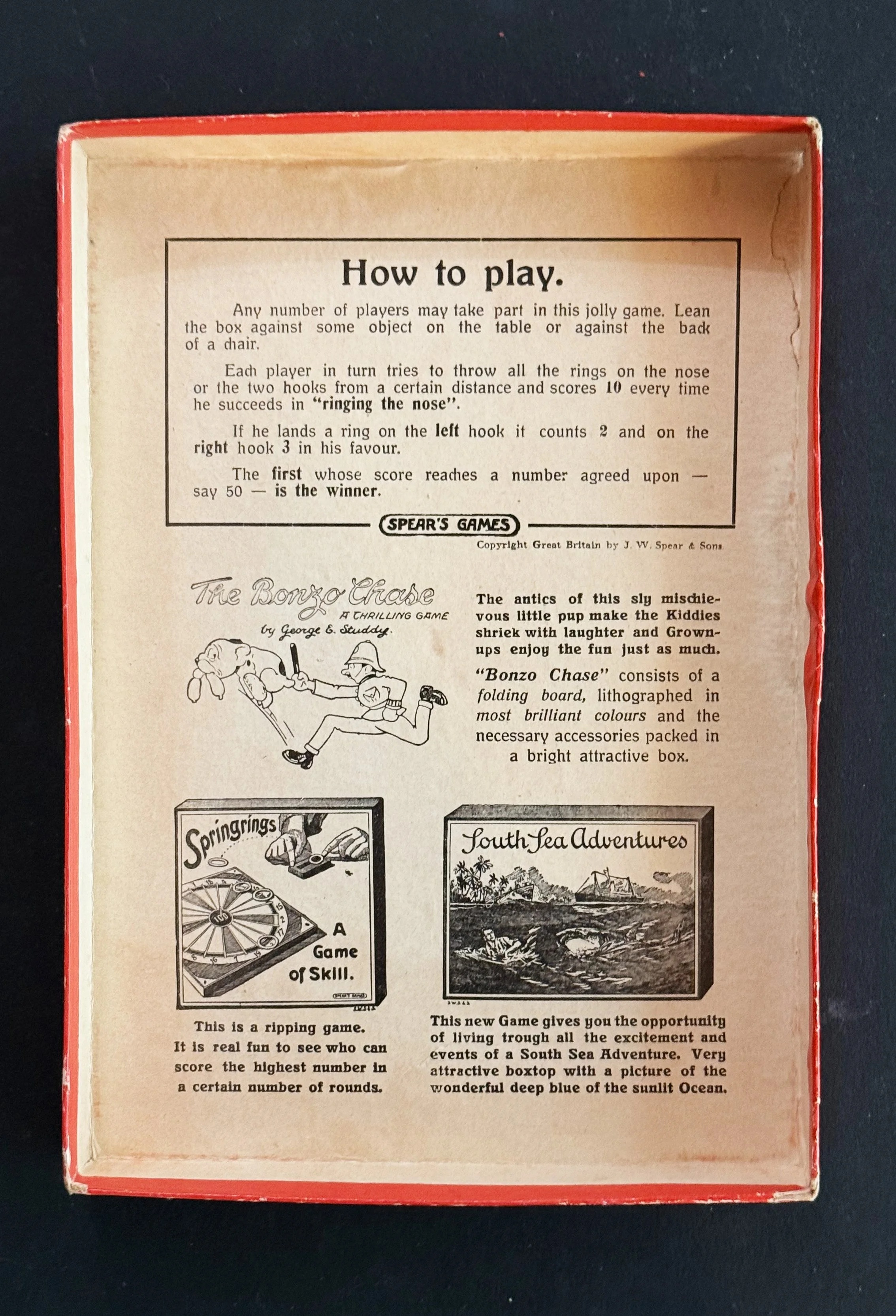 Image 3 of 4
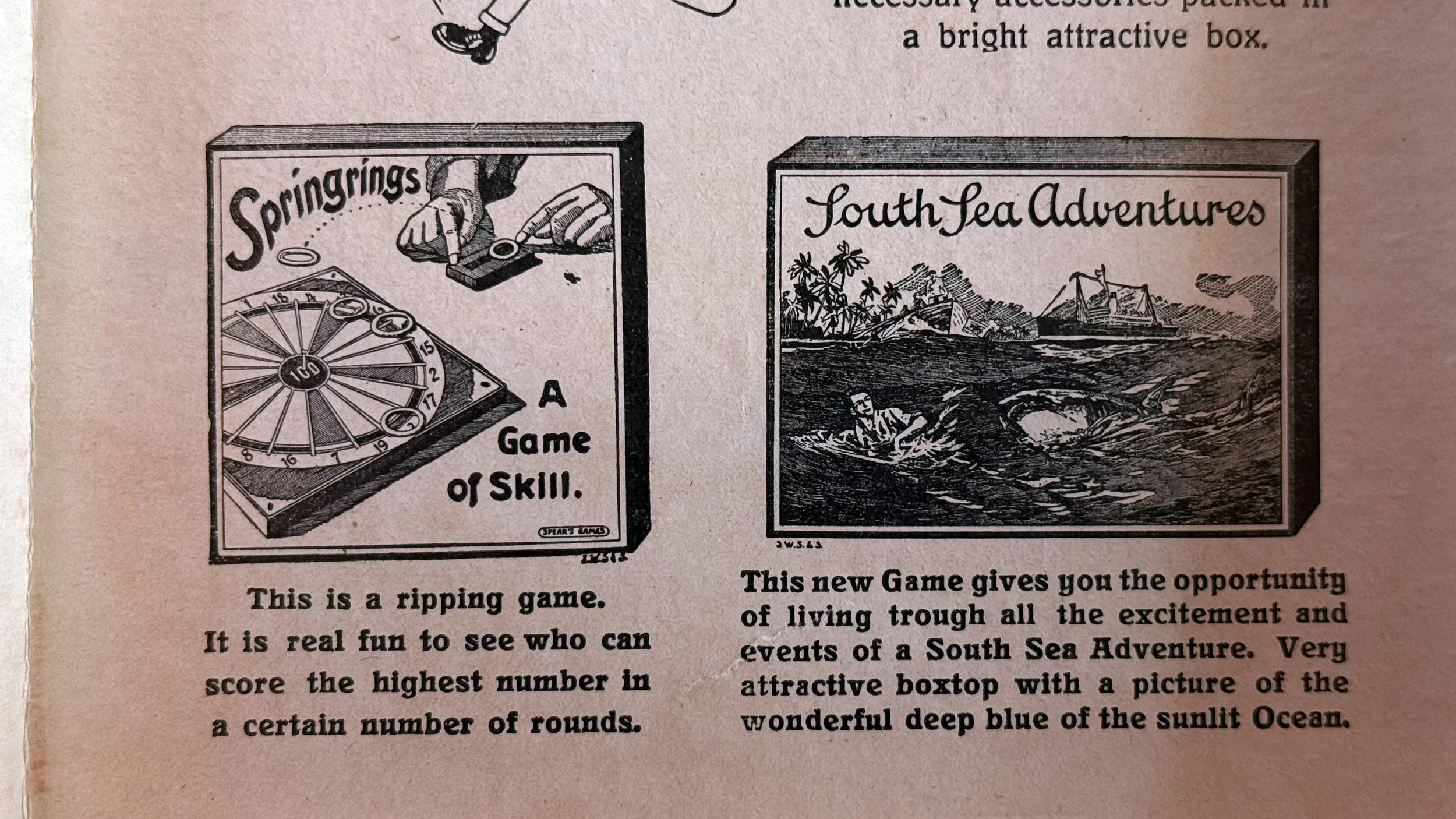 Image 4 of 4
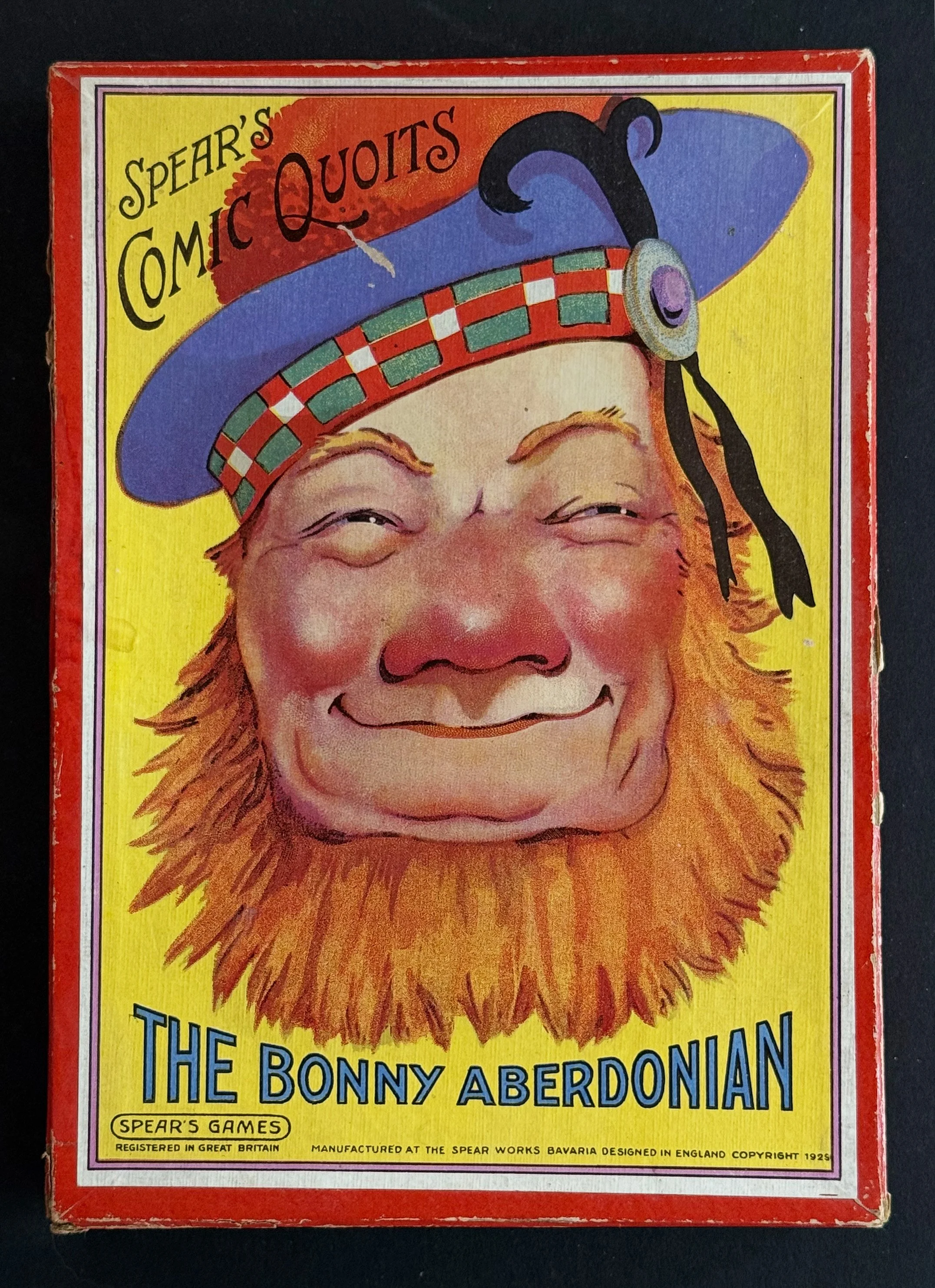
Of all the ring-toss games produced by J.W. Spear & Sons during the interwar years, the Comic Quoits series remains the most beloved—and the most delicate. Each title in the run staged a small theatrical face in chromolithograph, mounted inside a shallow lidded box, with the central character's nose rendered in three dimensions: a sculpted paper-pulp protrusion designed to receive a tossed wooden ring for the highest score. The Bonny Aberdonian, copyrighted 1929 and printed at the Spear Works in Bavaria, is one of the series' standout designs, and an increasingly rare survivor with its nose intact.
J.W. Spear & Sons traces to Nuremberg in 1879, where Jacob Wolf Spear founded a stationery and games concern that grew, by the early twentieth century, into one of Europe's most accomplished chromolithography workshops. The Spear Works at Bavaria became the firm's artistic engine: bright, dense lithographic colour on tinted card, applied to parlour games and educational toys distributed throughout Britain. The Comic Quoits series—Silly Sam, Comical Pete, Baby Jim, the Aberdonian—represented Spear's commercial peak in interwar Britain. Within a decade of this piece's production, the Spear family would flee Nazi Germany; the firm's UK arm would later produce Scrabble for the British market before being acquired by Mattel.
The Aberdonian's appeal is in its execution. The lid card carries a luminous yellow ground against which the Scotsman's red beard and tartan tam glow in characteristic Spear lithography—colour laid down in tight stippled passes that read almost as embroidery. Inside the box, the playing surface repeats the portrait at scale, with the sculpted nose pushing forward through a punched aperture. Two small steel hooks anchor in the beard as secondary targets. The nine ringed quoits—pale blue, butter yellow, blush pink, ivory—fall pastel against the saturated ground, a deliberate optical pairing of the kind Spear's designers were known for.
In play, the box could be hung vertically by its string mount or leaned against an object on a tabletop. Players took turns tossing the rings; the nose scored 10, the left hook 2, the right hook 3, and the first to reach fifty took the round. The underside of the lid carries the original Spear's-printed instructions alongside small period advertisements for companion titles in the Spear's catalogue—George Studdy's Bonzo Chase among them, the cartoon dog by then a national obsession—a complete graphic ecosystem of interwar British parlour amusement preserved on a single panel.
A parlour amusement of a kind largely vanished now—though the best of the surviving examples have begun to find their way back into private collections of British interwar design.
Maker: J.W. Spear & Sons | Production: The Spear Works, Bavaria (designed in England) | Date: Copyright 1929 | Dimensions: approx. 22 × 16 cm | Series: Spear's Comic Quoits | Components: Lid with original printed gameplay instructions and period advertisements · base with mounted playing card · sculpted nose (intact) · two steel hooks · nine wooden ringed quoits
Condition: Complete and original as issued. Lid graphics bright with strong colour retention. Box corners show wear with some softening and minor splits at edges. Playing surface inside the base remains crisp and unmarked; sculpted nose attached and undamaged. All nine quoits present in original pastel paint.
Of all the ring-toss games produced by J.W. Spear & Sons during the interwar years, the Comic Quoits series remains the most beloved—and the most delicate. Each title in the run staged a small theatrical face in chromolithograph, mounted inside a shallow lidded box, with the central character's nose rendered in three dimensions: a sculpted paper-pulp protrusion designed to receive a tossed wooden ring for the highest score. The Bonny Aberdonian, copyrighted 1929 and printed at the Spear Works in Bavaria, is one of the series' standout designs, and an increasingly rare survivor with its nose intact.
J.W. Spear & Sons traces to Nuremberg in 1879, where Jacob Wolf Spear founded a stationery and games concern that grew, by the early twentieth century, into one of Europe's most accomplished chromolithography workshops. The Spear Works at Bavaria became the firm's artistic engine: bright, dense lithographic colour on tinted card, applied to parlour games and educational toys distributed throughout Britain. The Comic Quoits series—Silly Sam, Comical Pete, Baby Jim, the Aberdonian—represented Spear's commercial peak in interwar Britain. Within a decade of this piece's production, the Spear family would flee Nazi Germany; the firm's UK arm would later produce Scrabble for the British market before being acquired by Mattel.
The Aberdonian's appeal is in its execution. The lid card carries a luminous yellow ground against which the Scotsman's red beard and tartan tam glow in characteristic Spear lithography—colour laid down in tight stippled passes that read almost as embroidery. Inside the box, the playing surface repeats the portrait at scale, with the sculpted nose pushing forward through a punched aperture. Two small steel hooks anchor in the beard as secondary targets. The nine ringed quoits—pale blue, butter yellow, blush pink, ivory—fall pastel against the saturated ground, a deliberate optical pairing of the kind Spear's designers were known for.
In play, the box could be hung vertically by its string mount or leaned against an object on a tabletop. Players took turns tossing the rings; the nose scored 10, the left hook 2, the right hook 3, and the first to reach fifty took the round. The underside of the lid carries the original Spear's-printed instructions alongside small period advertisements for companion titles in the Spear's catalogue—George Studdy's Bonzo Chase among them, the cartoon dog by then a national obsession—a complete graphic ecosystem of interwar British parlour amusement preserved on a single panel.
A parlour amusement of a kind largely vanished now—though the best of the surviving examples have begun to find their way back into private collections of British interwar design.
Maker: J.W. Spear & Sons | Production: The Spear Works, Bavaria (designed in England) | Date: Copyright 1929 | Dimensions: approx. 22 × 16 cm | Series: Spear's Comic Quoits | Components: Lid with original printed gameplay instructions and period advertisements · base with mounted playing card · sculpted nose (intact) · two steel hooks · nine wooden ringed quoits
Condition: Complete and original as issued. Lid graphics bright with strong colour retention. Box corners show wear with some softening and minor splits at edges. Playing surface inside the base remains crisp and unmarked; sculpted nose attached and undamaged. All nine quoits present in original pastel paint.