The interesting thing about this box is what Aladdin didn’t have to buy.
In the autumn of 1955 The Adventures of Robin Hood premiered on Britain’s new ITV network with Richard Greene in the lead. By January 1956 it was taking a 78% audience share in London and selling briskly into the United States, and for the next several years a great many children on both sides of the Atlantic wanted a longbow for Christmas. Aladdin Industries built this box directly into that wave and owed nobody a cent, because Robin Hood has been out of copyright for approximately six centuries.
You can see the arrangement in what’s missing from the lid. No actor, no series title, no studio mark — just “Robin Hood” in hand-lettered outline above an archery tournament, with the word TRADEMARK tucked beneath it. Aladdin was claiming the only thing available to claim: its own lettering. The Smithsonian holds this box in the National Museum of American History and its catalog reads the art as drawn from the 1938 Errol Flynn picture, though it hedges with a “seem to be.” Nobody has settled where the images actually came from, which is a fitting condition for a story that belongs to everyone.
The illustration is better than the format demanded. The lid is the tournament at the butts, with the royal box and striped pavilions behind. The body carries five more scenes all the way around: Robin sounding a horn beneath an oak, the quarterstaff duel on the log bridge, a monk parted from his purse, Friar Tuck carrying Robin across the stream, and the Merry Men moving up through the brush.
Condition is the honest part, and it is not light. This box went to school for years and the oxidation is moderate-to-heavy — freckled across the pale fields on the lid, mottled substantially on the back, climbing from the bottom rim on one side, and bloomed around the interior well. The photographs of the back and interior are the accurate ones; the front flatters it.
What’s held is the structure and the story: the original green handle still attached and uncracked, a working latch, no dents, no punctures, all five scenes legible, greens still deep. It has not been cleaned and should not be. Taking the rust off lithographed tin takes the lithography with it.
Offered as found.
The interesting thing about this box is what Aladdin didn’t have to buy.
In the autumn of 1955 The Adventures of Robin Hood premiered on Britain’s new ITV network with Richard Greene in the lead. By January 1956 it was taking a 78% audience share in London and selling briskly into the United States, and for the next several years a great many children on both sides of the Atlantic wanted a longbow for Christmas. Aladdin Industries built this box directly into that wave and owed nobody a cent, because Robin Hood has been out of copyright for approximately six centuries.
You can see the arrangement in what’s missing from the lid. No actor, no series title, no studio mark — just “Robin Hood” in hand-lettered outline above an archery tournament, with the word TRADEMARK tucked beneath it. Aladdin was claiming the only thing available to claim: its own lettering. The Smithsonian holds this box in the National Museum of American History and its catalog reads the art as drawn from the 1938 Errol Flynn picture, though it hedges with a “seem to be.” Nobody has settled where the images actually came from, which is a fitting condition for a story that belongs to everyone.
The illustration is better than the format demanded. The lid is the tournament at the butts, with the royal box and striped pavilions behind. The body carries five more scenes all the way around: Robin sounding a horn beneath an oak, the quarterstaff duel on the log bridge, a monk parted from his purse, Friar Tuck carrying Robin across the stream, and the Merry Men moving up through the brush.
Condition is the honest part, and it is not light. This box went to school for years and the oxidation is moderate-to-heavy — freckled across the pale fields on the lid, mottled substantially on the back, climbing from the bottom rim on one side, and bloomed around the interior well. The photographs of the back and interior are the accurate ones; the front flatters it.
What’s held is the structure and the story: the original green handle still attached and uncracked, a working latch, no dents, no punctures, all five scenes legible, greens still deep. It has not been cleaned and should not be. Taking the rust off lithographed tin takes the lithography with it.
Offered as found.
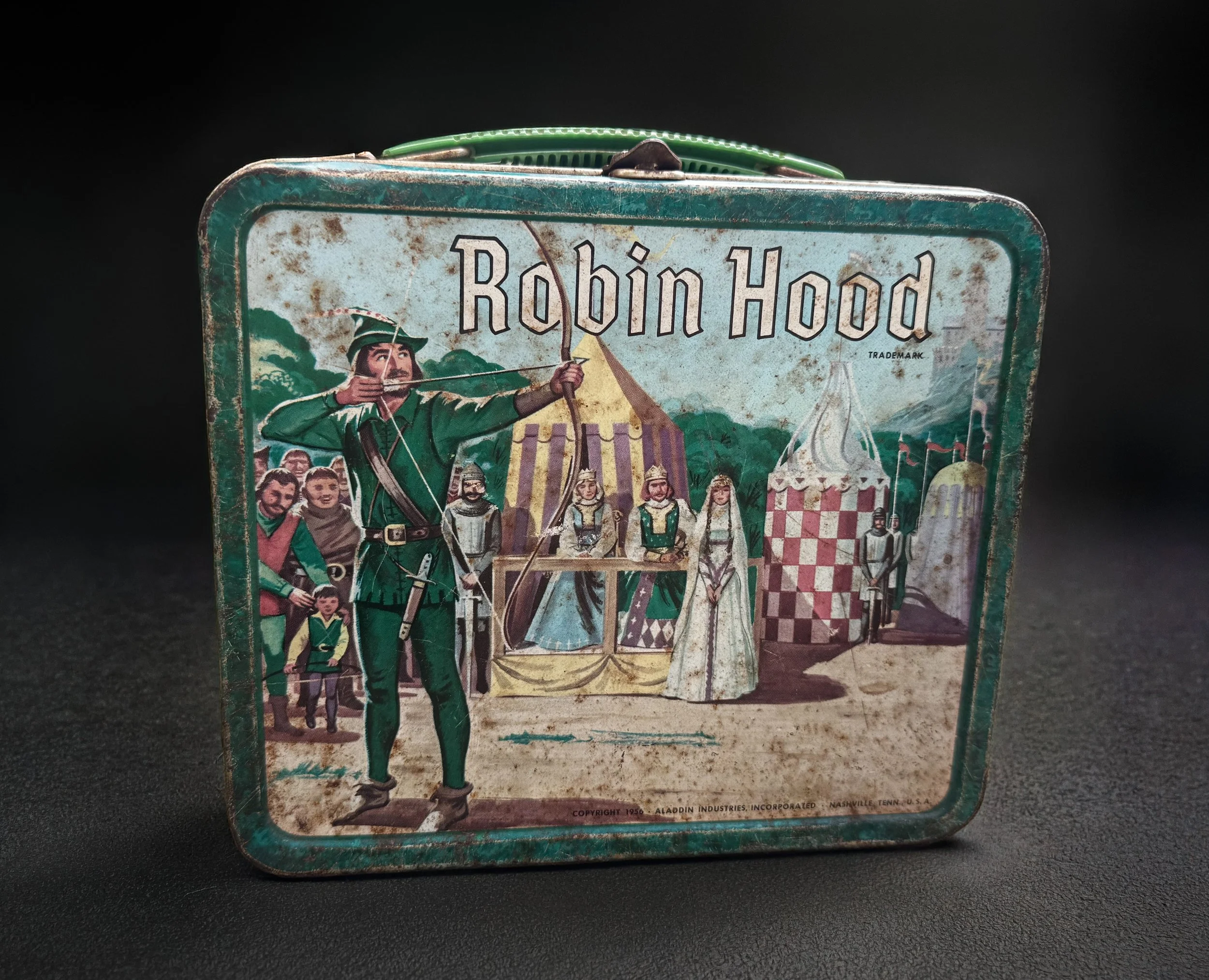 Image 1 of 8
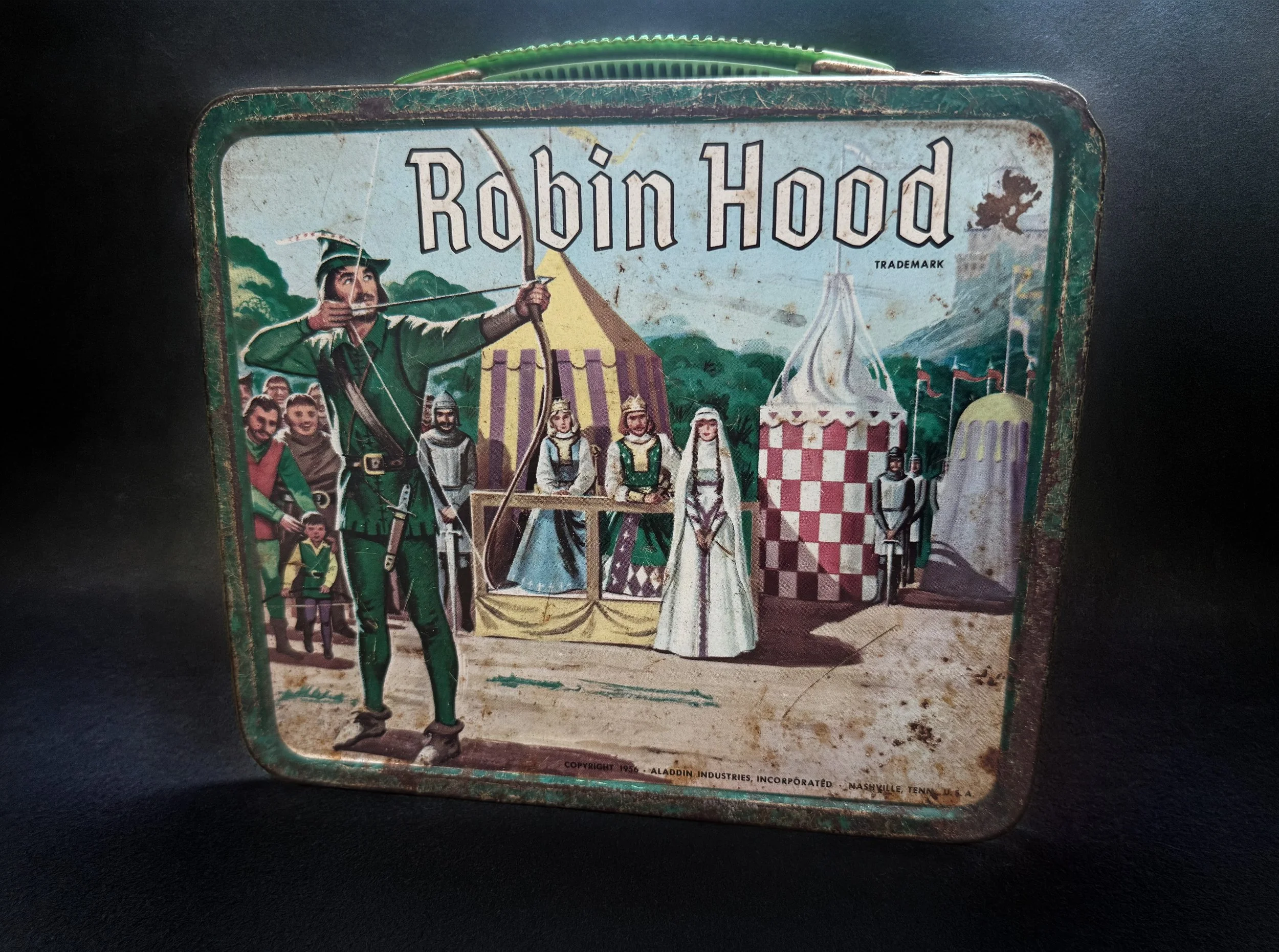 Image 2 of 8
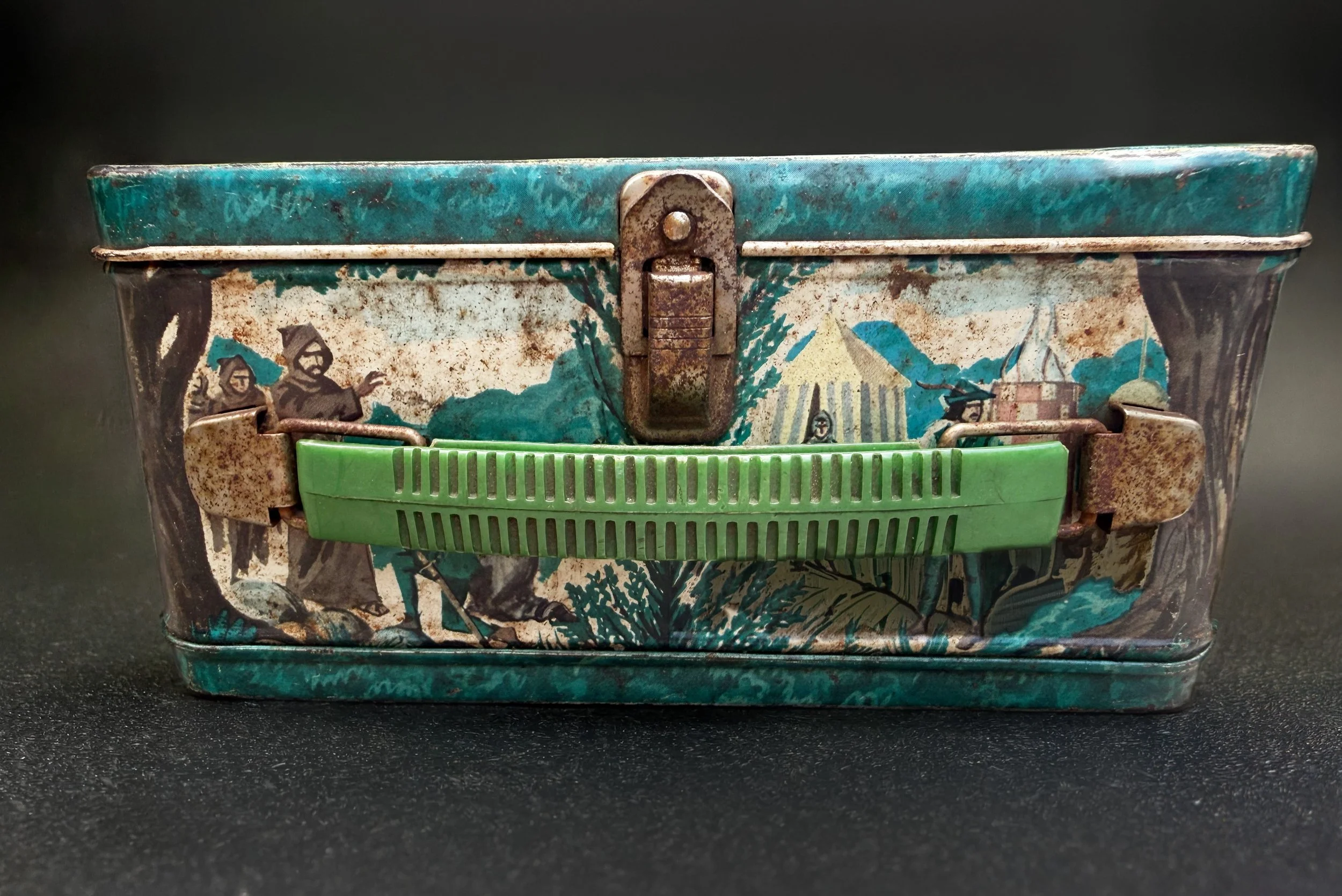 Image 3 of 8
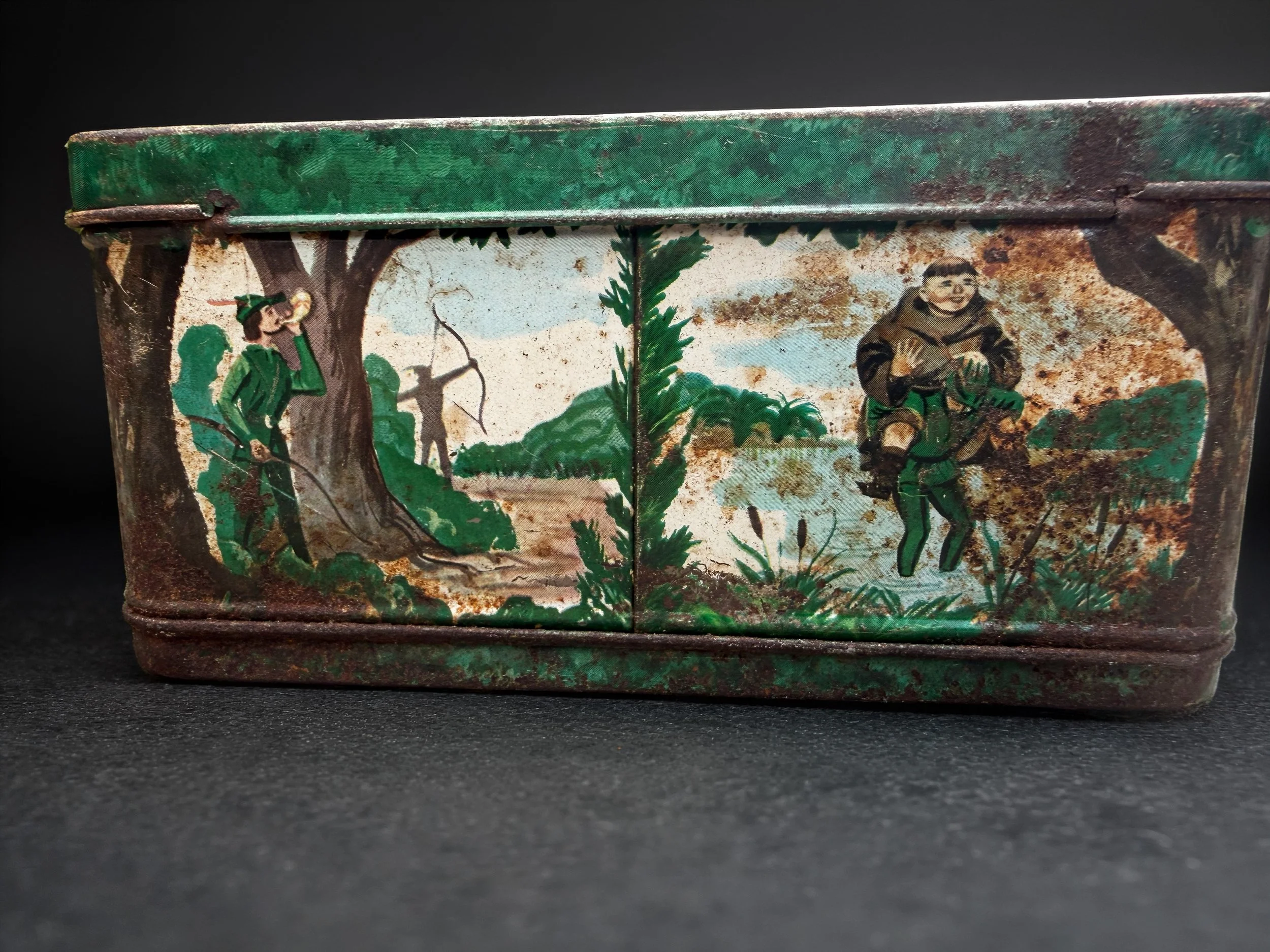 Image 4 of 8
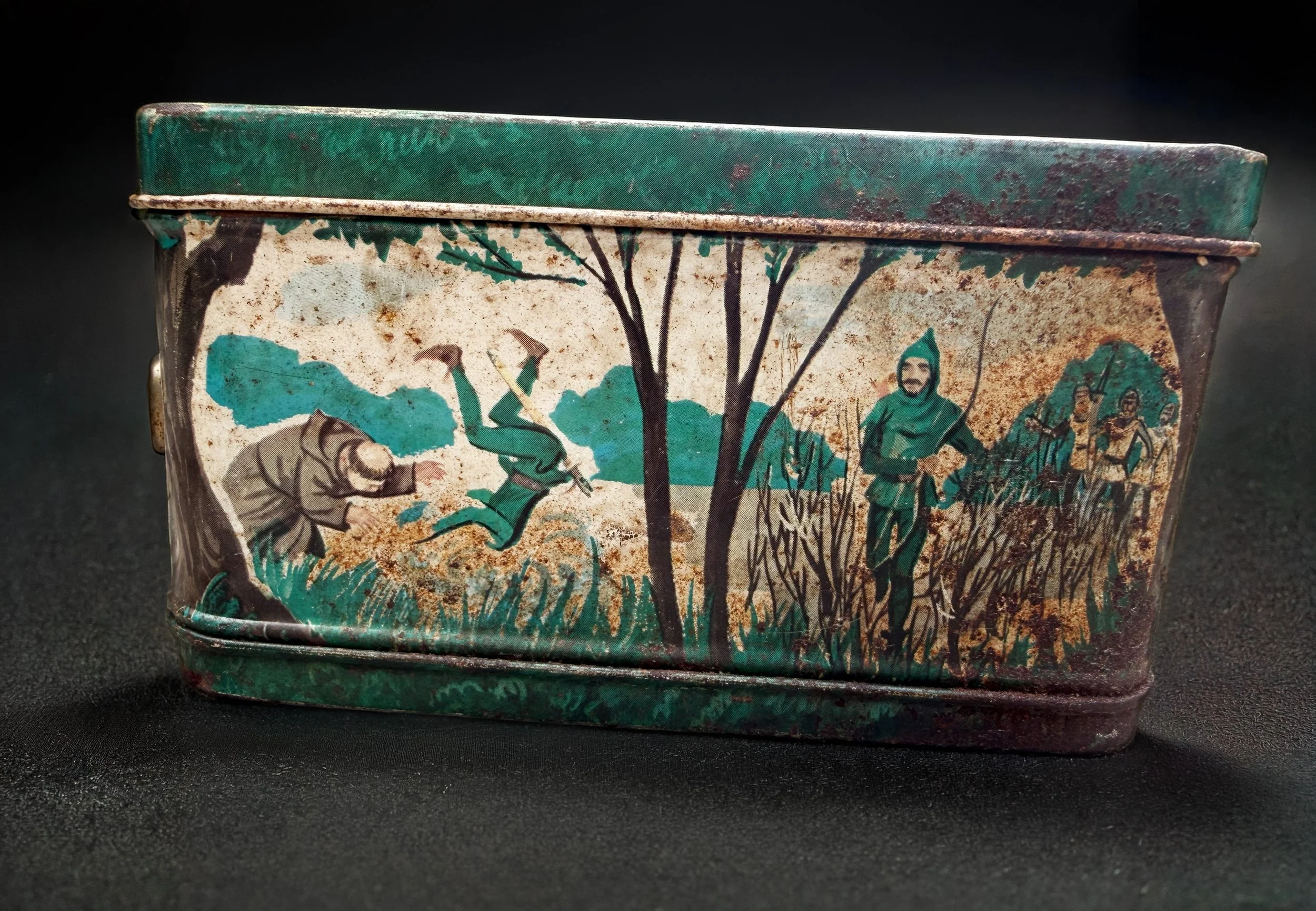 Image 5 of 8
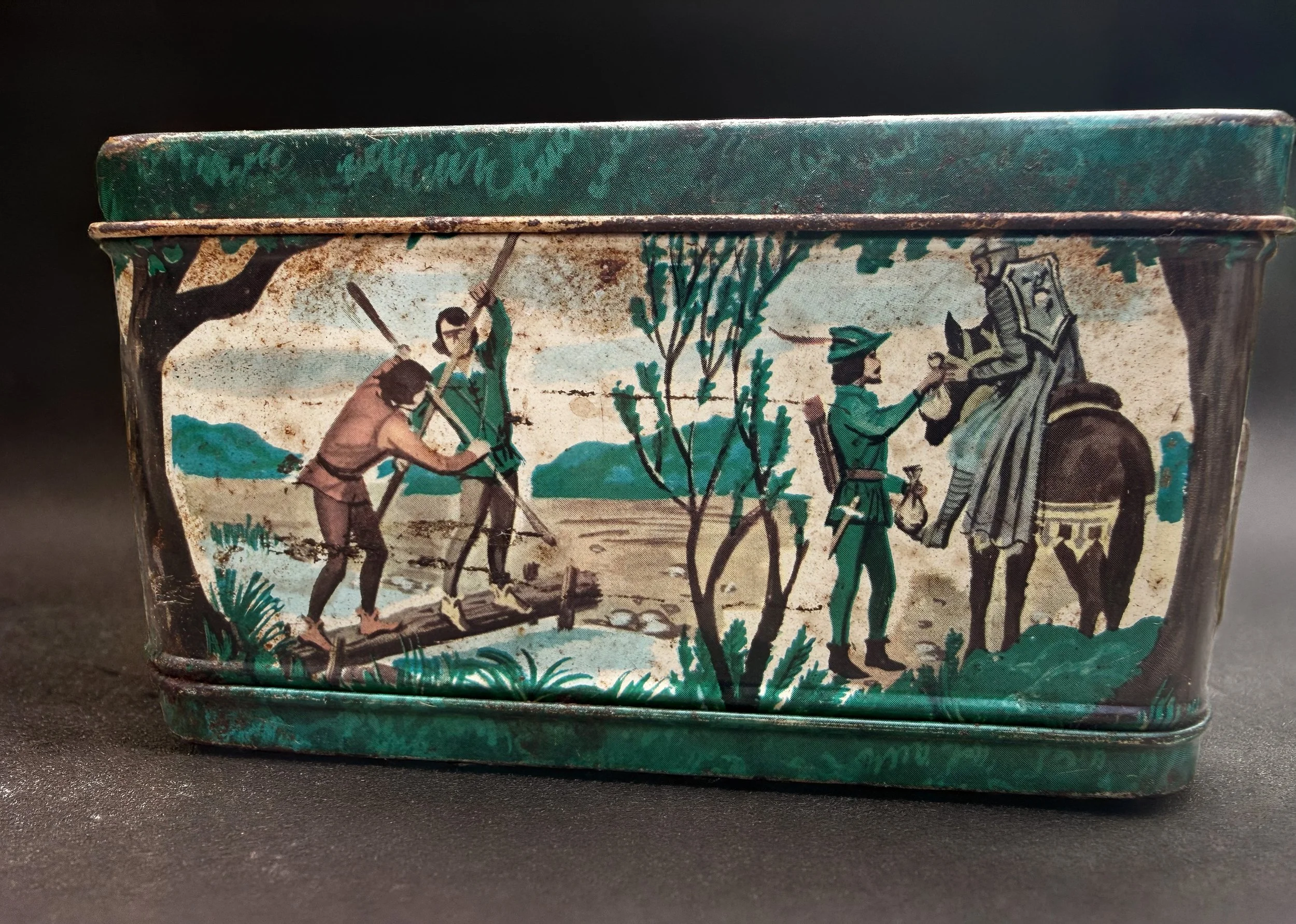 Image 6 of 8
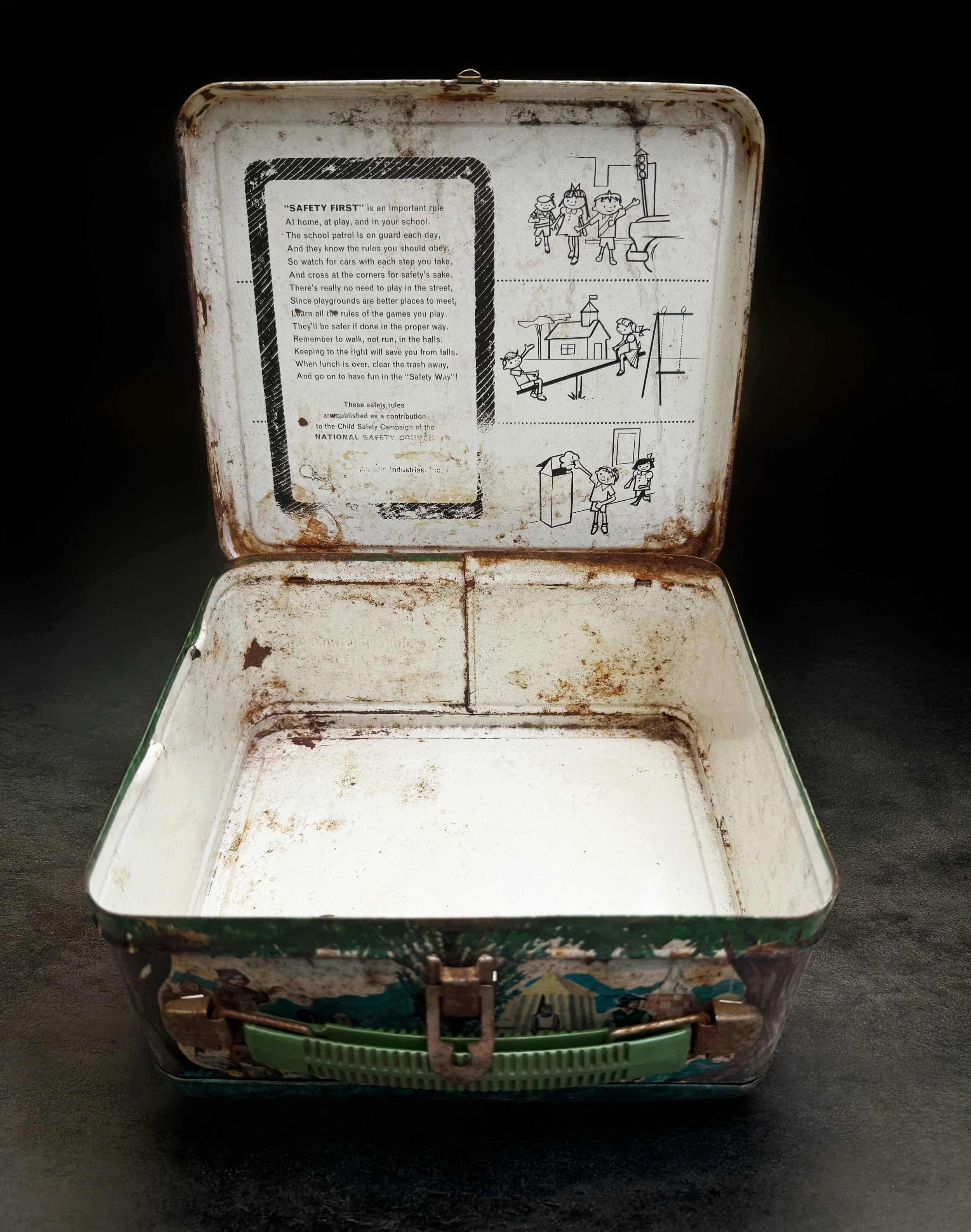 Image 7 of 8
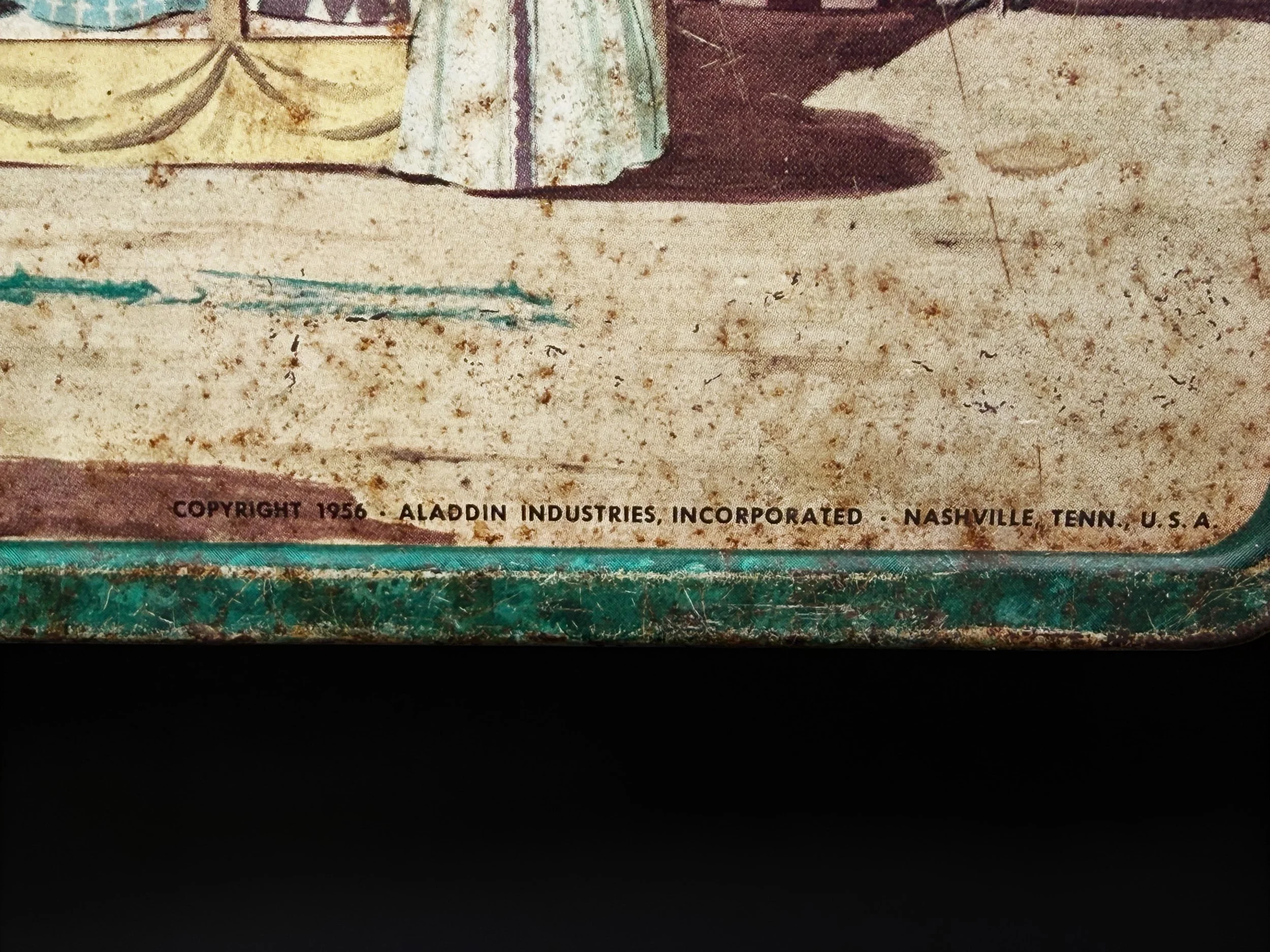 Image 8 of 8